How to Play Rock Paper Scissors: Rules and Strategy
Updated
Rock paper scissors is a hand game, usually played by two people. On the same count you each show one of three shapes: rock beats scissors, scissors beats paper and paper beats rock. If you both show the same shape, it is a tie and you play the round again.
The rules below follow Wikipedia and the tournament rules of the World Rock Paper Scissors Association, or WRPSA, which says there is no single global rulebook. With friends, agree on the details before you start.
The three throws
A throw is the shape you make with one hand.
| Throw | Your hand | Beats |
|---|---|---|
| Rock | A closed fist | Scissors, which rock crushes |
| Paper | A flat, open hand | Rock, which paper covers |
| Scissors | A fist with the index and middle fingers out in a V | Paper, which scissors cut |
Each throw beats one other throw and loses to another, so none of the three is stronger than the rest. This table shows every pairing from your side.
| You throw | Opponent shows rock | Opponent shows paper | Opponent shows scissors |
|---|---|---|---|
| Rock | Tie | You lose | You win |
| Paper | You win | Tie | You lose |
| Scissors | You lose | You win | Tie |
How to play a round
- Face your opponent and make a fist.
- Count together. Say "rock, paper, scissors" and swing your fist down on each word.
- On the fourth beat, usually the word "shoot", show your throw. Both players show at the same moment.
- Compare the throws. The shape that beats the other wins the round.
- If both shapes match, play again at once. A tie scores nothing for either player, and you throw as many times as it takes.
In the WRPSA rules you keep a closed fist during the count and reveal on "shoot", not before and not after.
How a match is scored
One round settles little, so most games run over several rounds. The WRPSA tournament rules use these formats.
| Format | How you win the match | Typical use |
|---|---|---|
| Best of three | First to win 2 rounds | Standard match |
| Best of five or longer (odd numbers) | First to win a majority of the rounds | Later rounds and finals |
The match ends as soon as one player reaches the majority, so you do not play the remaining rounds. With friends, any length works if you agree it first: one throw, first to three, or a longer series.
Fouls in tournament play
The WRPSA rules punish two timing fouls and illegal throws.
- False start. Opening your hand before "shoot" earns a warning and a replay the first time, and loses the round if you repeat it.
- Late throw. Delaying your reveal to react to your opponent's hand loses the round, and repeating it forfeits the match.
- Illegal throw. Use one hand, fully visible. A made-up or ambiguous shape is illegal and loses the round.
At a kitchen table you will not need a referee, but "no early hands and no late hands" is worth keeping.
How to win at rock paper scissors
You cannot beat a player who throws at random. Wikipedia states that it is impossible to gain an advantage over an opponent who picks their move uniformly at random. An advantage comes from predicting the other player, using psychology or the patterns in their past throws.
- Throw without a pattern. If you choose at random, nobody can gain an advantage over you. A favorite throw or a fixed order gives your opponent something to read.
- Watch what they do. Note what the other player throws after a win, after a loss and after a tie. Any habit you spot is something you can use.
- Treat repeated ties as a signal. The WRPSA notes that players who tie again and again are often mirroring each other. Change your approach on the next throw.
- Plan a short series. Players in tournaments often prepare their sequence of three throws ahead of time.
Rock paper scissors in your browser
Browser versions replace your hand with a click, a tap or a key, and each game sets its own rules, so read the instructions before the first round. They play free in the browser, with no install and no registration.
- Rock Paper Scissors has you choose rock, paper or scissors, and its instructions list what beats what. Its description puts you against a computer opponent that can play absolutely at random, so the advice above about a random player applies.
- Rock Paper Scissors Exclusive can be played with a friend or against the computer. Player one uses A, S and D for rock, paper and scissors. Player two uses the left, down and right arrow keys, with the left arrow for rock.
- Roshambo is another name for the same game. You play a friend or the computer, with touch controls or the keys A, S and D and J, K and L. The first to reach 3 points wins.
- Stone Sheet Shears is a twist on the classic, with real-time rounds of Stone, Sheet and Shears and several modes, according to its description. You play with the mouse or a tap.
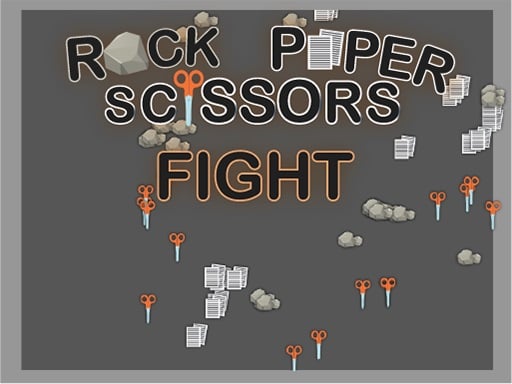
- Rock Paper Scissors Fight is a simulation, not a duel. Set how many rocks, papers and scissors there are and how fast they move, then watch them run across the field until only one type remains.


More games for two on one keyboard are in the two-player guide and the 2 player category. Tic tac toe is a different kind of game, because planning ahead works there: see how to win tic tac toe.
Names and bigger versions
The game is also called roshambo, rochambeau and jan-ken-pon. Wikipedia says the earliest form of a rock-paper-scissors-style game came from China and reached its modern standardized form in Japan.
Versions with more throws exist, with up to 101 different moves published. With an odd number of throws, the chance of a tie is 1 in that number: 1 in 3 with three throws and 1 in 5 with five.
Common questions about rock paper scissors
What beats what in rock paper scissors?
Rock beats scissors, scissors beats paper and paper beats rock. The same shape twice is a tie.
What happens when you tie in rock paper scissors?
You throw again straight away, as many times as it takes. In the WRPSA rules a tie is replayed immediately, with no limit, and scores nothing.
How does best of three work in rock paper scissors?
The first player to win 2 rounds wins the match, and play stops there. Best of five works the same way: the first to win 3 rounds takes it.
Can you win rock paper scissors every time?
No. Against a player who throws at random, nothing gives you an edge. Against a person, you can gain one by predicting their next throw from their past throws, and you can keep it from them by throwing without a pattern.
Know the cycle, agree how many rounds you are playing, and keep your throws free of patterns.