How to Play Carrom: Board Rules, Queen and Scoring
Updated
Carrom is a tabletop game from India in which you flick a heavy disc, the striker, to knock your own pieces into the four corner pockets. Each player owns one color, white or black, and the first to pocket all nine of their pieces wins the board, as long as the red queen has been pocketed and covered. A pot lets you shoot again, a foul costs you a piece.
Rules vary from club to club and from country to country. The rules below follow the International Carrom Federation (ICF) as described in the Wikipedia article on carrom, with the common differences noted.
The board and pieces
| Part | What it is |
|---|---|
| Board | A square board with a pocket in each corner; the ICF playing surface is 73.5 to 74 cm on each side |
| Carrom men | 9 white and 9 black discs, also called coins or pieces |
| Queen | One red disc, the most valuable piece |
| Striker | A larger, heavier disc you flick to hit the others |
| Baselines | Two parallel lines in front of each player; you shoot from between them |
| Diagonal lines | Arrows from each corner; your hand must not cross them when you shoot |
| Powder | Fine powder that helps the pieces slide |
Carrom is played by two players, or by four as two teams. To set up, place the queen on the center spot and arrange the 18 carrom men in a tight circle around it.
The toss and the break
Under ICF rules, the first shot is decided by a toss: the umpire hides a black piece in one hand and a white piece in the other, and the player who guesses right wins it. The winner of the toss takes the opening shot, the break, and plays white. The winner may instead switch sides and give the break to the opponent.
At home, most players simply agree who breaks.
How to play carrom, step by step
- Place the striker on your baseline. It must touch both lines, and either cover the circle at the end of the baseline completely or not touch it at all.
- Flick the striker with a finger. Pushing it is not allowed, and your hand or arm must not cross the diagonal lines.
- Aim to pocket pieces of your own color, either directly or by bouncing the striker off the board's edges.
- If you pocket one of your pieces, you shoot again. Your turn continues as long as you keep pocketing.
- If you pocket nothing, or commit a foul, the turn passes to your opponent.
- The first player to pocket all of their pieces, after the queen has been covered, wins the board.
Because a pot earns another shot, a strong player can clear all nine pieces and the queen in a single turn.
The queen and covering it
The queen is the piece most beginners get wrong.
- You may pocket the queen only after you have pocketed at least one of your own pieces.
- After pocketing the queen, you must cover it: pocket one of your own pieces with your next shot.
- If you fail to cover it, the queen goes back to the center of the board.
- You must not pocket your last piece while the queen is still on the board. In the professional rules, that loses you the board.
Rule sets disagree on one detail: whether the queen and a covering piece pocketed with the same shot count as covered. Some say yes, the ICF-based professional rules say no. Agree on it before you start.
Fouls and penalties
When you commit a foul, your turn ends and you pay a penalty, usually by returning one of your pocketed pieces to the center. A penalty you cannot pay yet, because you have pocketed nothing, is owed and paid later. This owed piece is often called a due.
| Foul | Usual penalty |
|---|---|
| Pocketing the striker | One of your pieces goes back, and you lose your turn |
| Pocketing an opponent's piece | You lose your turn; some rules treat it as a full foul with a piece returned |
| Crossing the diagonal lines with your hand | One of your pieces goes back |
| A piece jumps off the board | It goes back on the center spot; some rules also count it as a foul |
| Pocketing your opponent's last piece | You lose the board |
How a board is scored
In ICF-style rules, the winner of a board scores one point for each of the opponent's pieces still on the board, plus three points for the queen if the winner covered it. If the loser covered the queen, nobody gets those three points. The queen's points stop counting once your score reaches 21, and a game is played to 25 points.
Local rule sets change the numbers. Some tournaments, for example, give five points for the queen.
Point carrom and family games
- Point carrom: any player may pocket any color. Each carrom man is worth one point, the queen three, and the first to 25 points wins. It suits an odd number of players.
- Family-point carrom: a black piece is usually worth 10, a white 20 and the queen 50. The queen must still be covered.
Tips for beginners
- Practice the straight shot first. A piece sitting near a pocket, in a line with the striker, is the easiest pot on the board.
- Use the edges. Like a pool cushion, the edge sends the striker back at the same angle it came in. Bank shots reach pieces you cannot hit directly.
- Go for the queen early. Once you have one piece pocketed, an open queen is worth a shot, because three points and the right to finish depend on it.
- Watch your force. A hard shot scatters pieces and can send the striker into a pocket. A soft, accurate shot keeps your turn alive.
- Leave pieces in awkward places. When you cannot pot, try to leave your opponent's pieces against the edges or behind your own.
Play carrom in your browser
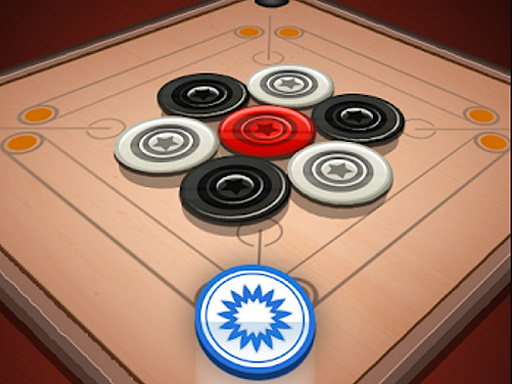
Carrom Pro has three modes: Classic Carrom with traditional rules and the queen, Disc Pool where you clear your pieces first, and Freestyle with point-based scoring. You drag to position the striker on the baseline, then pull back to set power and direction and release to shoot. It also has a pass-and-play mode for local play on one device.
Carrom 2 Player is a strike-and-pocket game played with the mouse: you aim and shoot the striker, and the zig-zag shots you know from a real board work here too.
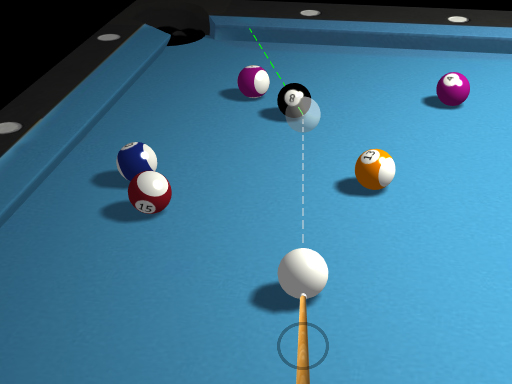
The site has two carrom games, so the rest of this list is close relatives that use the same aim, angle and power. Pool: 8 Ball Mania follows standard eight-ball rules against the computer or a friend, 3d Billiard 8 ball Pool is another eight-ball table, and in Coin Flick Soccer you flick a coin across a board, off the nails and into the goal.



For more of this kind, open the billiards collection or the 2-player category. The pool rules carrom players will recognize are in 8 ball pool rules, and if the family moves on to another board game, see how to play ludo.
Common questions about carrom
Can you hit the queen first in carrom?
You can hit it at any time, but you may pocket it only after you have pocketed at least one of your own pieces.
What happens if you pocket the striker?
It is a foul. You return one of your pocketed pieces to the center and your turn ends. If you have none yet, you owe one.
How many points is the queen worth?
Three points under ICF-style rules, and only if the winner of the board covered it. Some local rules give five, and family games often give 50.
Can you use your thumb in carrom?
The ICF allows shooting with any finger, including the thumb. Some local rules ask for one finger only.
Pocket one piece first, cover the queen right after, and the rest of carrom is angles and touch.