How to Play Mahjong Solitaire: Rules and Tips
Updated
Mahjong solitaire is a one-player matching game: you remove identical tiles in pairs until the board is empty. You may only take tiles that are free, which means nothing covers them and their left or right side is open. Clear every tile and you win; if no free pair is left, the deal is lost unless your version lets you shuffle.
The rules of mahjong solitaire
A classic board uses 144 tiles stacked in layers, and the usual starting layout is called the turtle. All tiles lie face up, so you can see every tile that is not covered. Your goal is to clear the whole board.
- Look for two identical tiles that are both free.
- Click or tap one, then the other, and both leave the board.
- Removing a pair opens up the tiles that were under it or beside it.
- Keep going until the board is empty, which is a win.
- If no free pair remains, you are stuck: undo, shuffle or start again, depending on what the game offers.
That is the whole rulebook. Every decision you make is about which free pair to take first.
What makes a tile free
A tile is free when two things are true at the same time:
- No other tile covers it, not even partly.
- Its left side or its right side is open, with no tile directly next to it on that side.
Neighbors in the rows above and below it on the screen do not matter; only the left and right sides count. A tile in the middle of a row stays locked until one of its neighbors is gone, so long rows open up from the ends.
| Where the tile is | Free? |
|---|---|
| End of a row, nothing covering it | Yes |
| Middle of a row, both neighbors still there | No |
| Middle of a row, nothing covering it, the tile on its left already removed | Yes |
| Any tile with part of another tile resting on it | No |
Some browser versions use their own rule, so read the instructions once. Halloween Mahjong Deluxe asks for at least two adjacent sides to be open, while Gem Mahjong counts a tile as free when nothing covers it.
Tiles, flowers and seasons
A full set has three suits, two groups of honor tiles and eight bonus tiles. Most tiles come in four identical copies, so each one leaves the board as two pairs over a game.
| Tile group | Copies | What it matches |
|---|---|---|
| Dots, bamboo and characters, numbered 1 to 9 | 4 of each | Only an identical tile |
| Winds: east, south, west, north | 4 of each | Only the same wind |
| Dragons: red, green, white | 4 of each | Only the same dragon |
| Flowers | 4 different tiles | Any other flower |
| Seasons | 4 different tiles | Any other season |
Flowers and seasons are the only tiles that pair without being identical. A flower never matches a season, though. In Mahjong Master 2, for example, the instructions say that flower tiles match with each other.
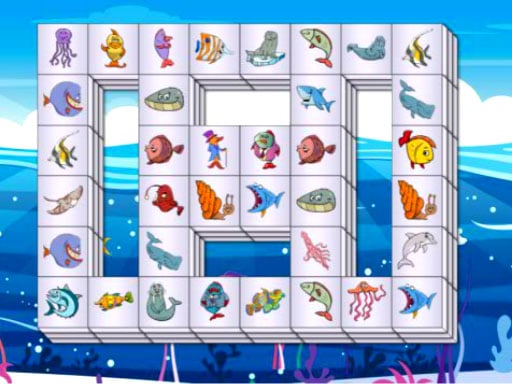
Many browser versions swap the classic symbols for birds, gems, sea creatures or travel pictures. The rule does not change: two identical pictures make a pair.
Tips that clear more boards
- Work on the tallest stacks and the longest rows first. Tiles buried under a stack or deep inside a long row are the hardest to reach, so open them early.
- When all four copies of a tile are free, take both pairs. Nothing can go wrong with that move.
- When three copies are free, stop and look. Take the pair that opens the most new tiles, or the one that frees the hidden fourth copy.
- Watch for two identical tiles lying one on the other. Each of them needs a partner from the other two copies, so never pair those two copies with each other.
- Before every match, ask what it opens. A pair that frees nothing can usually wait.
- Use hints and undo when the game has them. Travel Mahjong Deluxe has a Hint feature, and Mahjong Mania lets you undo your last match.
Speed only matters in some versions. Mahjong Master 2 gives bonus points for quick matches, and Kitchen Mahjong runs against a clock and turns saved time into a bonus.
Play mahjong solitaire in your browser
Most of the games below describe the classic pair rules: match two identical free tiles until the board is empty. Mahjong Bird Tiles spells out the free-tile rule in its instructions, and Mahjong Quest can also finish a level once you find all of its special tiles. No install and no registration: they play free, right in the browser.





For more tile games, open the mahjong collection or the puzzles category. If you also play patience with cards, how to play solitaire covers Klondike.
Variants: triple tiles, trays and timers
Not every mahjong game on a screen follows the classic rules. These are the changes you will meet in the catalog.
| Variant | What changes | Example |
|---|---|---|
| Triple tiles | Match three identical free tiles instead of two | Summer Triple Mahjong |
| Tray | Tiles you clear go to a tray at the bottom; a full tray ends the level | Gem Mahjong |
| Stricter free rule | Two adjacent sides must be open | Halloween Mahjong Deluxe |
| Timer | Clear the board before the clock runs out | Kitchen Mahjong |
The pair-matching habits above still help in all of them. Triple versions simply ask you to count to three instead of two.
Common questions about mahjong solitaire
Is every mahjong solitaire game winnable?
No. An analysis of ten million deals on the turtle layout found that about 3 percent cannot be cleared even if you could see under the tiles. Many computer versions avoid this by dealing only boards that can be cleared, or by letting you shuffle when you are stuck.
Can you match any flower with any flower?
Yes. In the classic rules any flower pairs with any other flower and any season with any other season. Every other tile needs an exact twin.
What happens when there are no moves left?
The deal is lost unless the game gives you a way out. Some versions shuffle the remaining tiles, and many offer undo, so you can step back and choose a different pair.
Is mahjong solitaire the same as mahjong?
No. Mahjong solitaire borrows the tiles of mahjong, the four-player game, but you play it alone and the rules are unrelated. It began as a computer game in 1981.
Once you can spot a free tile at a glance, every layout plays by the same short set of rules.