How to Play Minesweeper: Rules, Numbers and Patterns
Updated
Minesweeper is a logic puzzle played on a grid of covered squares, some of which hide mines. When you open a safe square, it shows a number: how many mines touch it, counting the eight squares around it. You win by opening every safe square, and the game ends the moment you open a mine.
Minesweeper rules
- Click or tap a covered square to open it.
- If the square hides a mine, the game is over.
- If it is safe, it shows a number from 1 to 8: the count of mines in the squares touching it, including diagonals.
- If no mine touches it, the square opens blank, and its neighbors open automatically. That is how one click can clear a large area.
- Mark a square you are sure hides a mine with a flag. On a computer this is usually a right click; on a phone many versions use a long press.
- You win when every square without a mine is open. You do not have to flag the mines to win.
Most versions show two counters: the time and the number of mines left, which is the total number of mines minus the flags you have placed. A wrong flag still lowers that counter, so it is a guide, not a proof.
What the numbers mean
A number only ever talks about the squares touching it. A square in the middle of the board has eight neighbors, a square on an edge has five, and a corner square has three.
| What you see | What it tells you |
|---|---|
| A blank, open square | None of its neighbors is a mine; they open on their own |
| A 1 | Exactly one mine among its covered neighbors |
| A number equal to its covered neighbors | Every one of those covered squares is a mine |
| A number already touching that many flags | All its other covered neighbors are safe |
Those last two rows solve a surprising share of every board. Most of the game is repeating them square by square.
Board sizes and difficulty
Most Minesweeper games offer three standard levels, plus a custom board. These sizes come from Wikipedia's Minesweeper article.
| Level | Board | Mines |
|---|---|---|
| Beginner | 9×9, or 8×8 in some versions | 10 |
| Intermediate | 16×16 | 40 |
| Expert | 30×16 | 99 |
Expert hides about one mine in every five squares, against about one in eight on Beginner, so the clues around each mine are much tighter.
How to start a game
In many versions the first click is always safe, and some also keep its neighbors clear so that you get an opening. Check your game's own instructions before you rely on it.
A common way to start is to open squares until you get a large opening. If your first click shows a single number and nothing else, open another square away from it. Once you have an open area with numbers along its edge, switch to logic.
Patterns that solve the board
Experienced players stop counting and start recognizing patterns. These come from the patterns page at minesweepergame.com. Each one reads along a straight line of numbers that faces a line of covered squares.
- 1-2-1: the mines sit opposite the two 1s, and the square opposite the 2 is safe.
- 1-2-2-1: the mines sit opposite the two 2s, and the squares opposite the 1s are safe.
- 1-2 and the next square: reading from a 1 to a 2, the covered square just past the 2 is a mine. The 1-2-1 and 1-2-2-1 patterns are this rule applied from both ends.
- 1-1 from a wall: when a row starts 1-1 against the edge of the board, the third covered square from the edge is safe.
- A 1 in a corner already touching a mine: its other neighbors are safe. Players call this a fake 1, because it looks like a new clue but is already used up.
Chording: opening squares faster
When a number already touches as many flags as its value, you can open all its other neighbors at once. This is called chording. On a computer it is usually done by pressing both mouse buttons together on the number; other versions have their own control, so check the game's instructions.
Chording only works if your flags are right. If you flag the wrong square, the chord opens a mine.
When you have to guess
Some positions cannot be solved by logic, often near the end: two squares, one mine, and no other clue. When that happens:
- Solve everything else on the board first. A clue elsewhere may settle the guess for free.
- Check the mine counter. With one mine left, any covered square outside the doubtful area is safe.
- When you must guess, pick the square that would give you the most new information if it is safe.
Common mistakes
- Forgetting the diagonals. A number counts all eight surrounding squares, not just the four beside it.
- Trusting a flag you placed in a hurry. One wrong flag makes every number around it misleading.
- Guessing while safe moves are still on the board. Scan every edge of the open area before you take a risk.
- Rushing the last few squares. The end of a board needs the same checks as the start.
Play Minesweeper in your browser
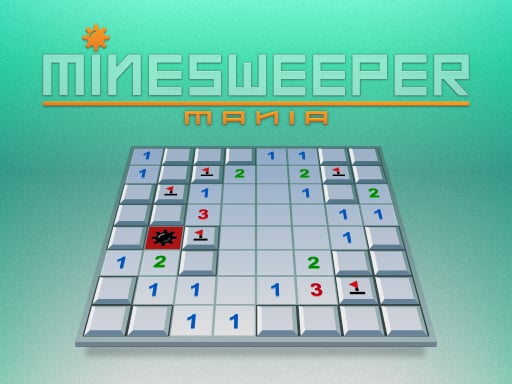
Minesweeper Mania follows the classic rules: open every square that does not contain a mine, using numbers that count the mines in the eight neighboring squares. It lets you try higher difficulty levels, customize levels, change themes and use hints.
Minesweeper: Find Bombs opens cells with a left click and plants or removes a flag with a long press; the goal is to clear the field without hitting a mine. Abyss Sweeper is a variant: you dig safe tiles to reveal number clues on a never-ending grid, and harvest mines you have located to refill your fuel.
Two close relatives use the same kind of deduction. Nonogram - Picture Cross gives number clues for each row and column, and you color squares to reveal a picture. Sudoku runs from Easy to Insane, and sudoku rules and tips explains how it works.


For more logic games, open the puzzles category or the brain collection.
Minesweeper FAQ
What do the numbers mean in Minesweeper?
Each number is the count of mines in the squares touching it, including the diagonals. A 3 means exactly three of its neighbors are mines.
Is the first click always safe?
In many versions, yes, and some also clear the squares around it. It is not a rule of every Minesweeper game, so check the one you are playing.
Can you always win Minesweeper without guessing?
No. Some boards reach a point where two or more layouts fit every clue. Logic gets you through most of a board, but now and then a guess is the only way on.
How do you play Minesweeper on a phone?
Tap to open a square. Flags usually go on with a long press; check the game's own instructions for the exact control.
Read each number against the squares around it, and Minesweeper turns from luck into logic.