How to Play 2048: Rules, Corner Strategy and Tips
Updated
2048 is played on a 4×4 grid of numbered tiles. Each move slides every tile as far as it can go in one direction, and two tiles with the same number merge into one tile worth their sum. You win when a 2048 tile appears, and the steadiest way to get there is to keep your biggest tile in one corner with a descending chain beside it.
How 2048 works
The game starts with two tiles, each a 2 or a 4. You move with the arrow keys, or by swiping on a touch screen, and every tile on the board moves at once.
- Tiles slide until they hit the edge of the grid or another tile.
- Two tiles with the same number that collide merge into one tile with their sum: 2 and 2 make 4, 4 and 4 make 8.
- A tile made by a merge cannot merge again in the same move.
- After each move, a new tile appears in a random empty square. It is a 2 nine times out of ten and a 4 the rest of the time.
- Your score goes up by the value of every tile you create by merging.
- The game ends when the grid is full and no two neighboring tiles match.
Reaching 2048 counts as a win, but you can keep playing for a bigger tile and a higher score.
What one move does
Here is one row before and after a move to the left. A dot marks an empty square.
| Row before | After moving left | Why |
|---|---|---|
| 2 · 2 · | 4 · · · | The two 2s slide together and merge |
| 2 2 2 · | 4 2 · · | With three equal tiles, only the pair nearest the left edge merges |
| 2 2 2 2 | 4 4 · · | Four equal tiles merge as two pairs |
| 4 2 2 · | 4 4 · · | The new 4 cannot merge again in the same move |
The corner strategy, step by step
The corner strategy keeps your biggest tile in one corner and lines up the next-biggest tiles beside it. Wikipedia's article on 2048 sums up the same idea: the largest tile in a corner, with other large tiles filling its row. This example uses the bottom-left corner.
- Put your biggest tile in the bottom-left corner.
- Use two moves most of the time: Down and Left. Both press the big tile into its corner.
- Use Right only when the bottom row is full. A full row with no matching neighbors cannot slide, so the corner tile stays put.
- Avoid Up. If it is the only move left, make it when the left column is full and has no matching neighbors, so the corner tile cannot rise and a new tile cannot land in its place.
- Fill the bottom row in descending order from the corner, for example 256, 128, 64, 32.
Build a chain
When the bottom row is in order, continue the chain on the row above it, running the other way. The 16 goes above the 32, the 8 to its left, and so on. Each new tile you build then sits right next to the tile it needs to merge with.
When you finally make a tile that matches the end of the chain, the chain collapses toward the corner one step per move. Two 32s make 64, the 64 merges with the 64 beside it, then the 128, then the 256.
Keep the board open
- Watch the empty squares. When only a few are left, stop building and look for merges that free space.
- Merge small tiles near the end of the chain, not in the far corner of the grid.
- Keep your second-biggest tile next to your biggest one, never on the other side of the board.
Common mistakes
- Swiping fast in all four directions. Random moves scatter the big tiles, and a scattered board fills up quickly.
- Pressing Up with a gap in the corner column. The big tile leaves its corner, and a new tile can land where it was.
- Trapping a small tile between big ones. A 2 stuck between a 64 and a 128 blocks that row until something around it merges.
- Building two big tiles far apart. Two 128s on opposite sides of the grid take many moves to meet.
- Chasing every merge. A merge that pulls the corner tile out of place costs more than it gains.
2048 versions to try
The same slide-and-merge rules work on other boards. Each of these is free to play in the browser, with no install and no registration.
- 2048 Premium offers 4×4, 5×5 and 6×6 grids, with Undo, Swap and Delete power-ups.
- 2048 Hexa Merge Block moves the tiles on a hexagon board.
- 2244 Number Match lets tiles move in eight directions.
- Money 2048 swaps the numbers for coins, wallets, cash bundles and money bags.


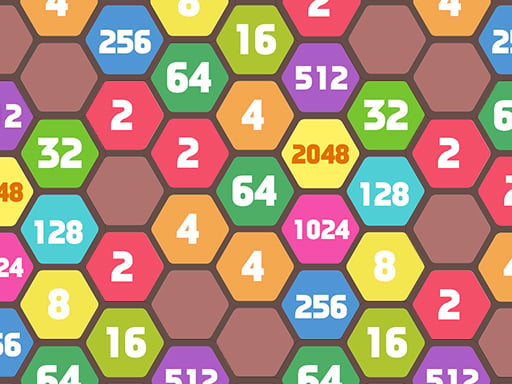

A larger grid gives you more empty squares, so the corner strategy has more room to work. On a hexagon board or with eight directions, each tile has more neighbors, so check the game's own instructions before you plan a chain.
Drop and shoot variants
Some games keep the 2048 numbers but change the move. In Drop & Merge 2048, numbered cubes fall into five lanes and merge when they match. In 2048 Shoot Merge Number 3D you shoot number blocks to merge them, and in Cube Merge Game you drop numbered cubes and merge the matching ones.


For other kinds of merging, from fruit drops to idle factories, see what merge games are. If you like grid planning without the merging, block puzzle tips covers games where full rows and columns clear. More number and logic games are in puzzles.
FAQ
Can you always win 2048?
Not every time. New tiles appear in random empty squares, so luck plays a part in each game. The corner strategy keeps more of the board under your control, and that makes a win much more likely.
What is the highest tile in 2048?
On the standard 4×4 board, the largest tile possible is 131,072. Reaching 2048 already counts as a win, and you can keep going past it.
Is 2048 luck or skill?
Both. Where each new tile lands is random, but your moves decide how much room you have when it lands. A tidy corner and chain leave space for bad luck; a scattered board does not.
Who made 2048?
Italian developer Gabriele Cirulli released 2048 in March 2014. He called it conceptually similar to the mobile game Threes, and it grew out of an earlier game called 1024.
The rules take a minute to learn; the corner and the chain are what turn them into wins.