How to Play Backgammon: Setup, Rules and Bearing Off
Updated
Backgammon is a race for two players. Each player has 15 checkers on a board of 24 points, moves them around a horseshoe-shaped track by rolling two dice, and then takes them off the board. The first player to bear off all 15 checkers wins, and along the way a single checker left alone can be hit and sent back to the start.
The backgammon board
The board has 24 narrow triangles called points, in four quarters of six. Each player numbers the points from their own side, so your 24-point is your opponent's 1-point.
| Part | What it is |
|---|---|
| Home board | Your points 1 to 6, where all your checkers must gather before you can bear off |
| Outer board | Your points 7 to 12 |
| Bar | The ridge down the middle that splits the board in two; hit checkers wait here |
| Bar point | Your 7-point, just outside your home board |
| Midpoint | Your 13-point, on the far side of the board |
You and your opponent move in opposite directions. Your checkers travel from your 24-point down toward your 1-point and then off the board.
Backgammon setup
Each player places their 15 checkers on four points. Your opponent's checkers sit on the same points counted from their own side.
| Point | Checkers |
|---|---|
| 24-point, in your opponent's home board | 2 |
| 13-point, the midpoint | 5 |
| 8-point, in your outer board | 3 |
| 6-point, in your home board | 5 |
That makes 15. The two checkers on the 24-point are called your back checkers, because they have the longest way to go.
How to play backgammon, step by step
- To start, each player rolls one die. The higher number moves first and plays both numbers just rolled. On a tie, both roll again, so the first move is never a double.
- After that, players take turns rolling two dice.
- Each die is a separate move. With 6 and 3, move one checker six points and another three, or move one checker nine points, as long as the point where it stops in between is open.
- A double is played four times. A roll of 5 and 5 gives you four moves of five.
- A checker may land on an empty point, a point with your own checkers, or a point with exactly one opposing checker. A point with two or more opposing checkers is blocked.
- You must use both numbers if you legally can. If you can play either number but not both, you must play the larger one. If neither can be played, you lose the turn.
These rules follow the rules of backgammon at bkgm.com.
Hitting, the bar and entering
A single checker alone on a point is a blot. If your opponent lands on it, it is hit and goes onto the bar.
- While you have a checker on the bar, you must bring it back in before you move anything else.
- It enters in your opponent's home board, on the point that matches one of your dice: a 1 enters on your 24-point, a 6 on your 19-point.
- If both numbers land on blocked points, you cannot enter and your turn is over.
- If your opponent holds all six points of their home board, you cannot enter at all until one of those points opens.
Bearing off
Once all 15 of your checkers are in your home board, you may start taking them off.
- A roll that matches a point removes a checker from it: a 4 bears off a checker from your 4-point.
- If that point is empty, you must make a legal move with a checker on a higher point.
- If there are no checkers on higher points, you remove a checker from the highest point you still occupy.
- You may move a checker inside your home board instead of bearing off, as long as the move is legal.
- If one of your checkers is hit during this stage, it must travel all the way back to your home board before you continue bearing off.
How you win: single game, gammon and backgammon
| Result | When it happens | Points |
|---|---|---|
| Single game | The loser has borne off at least one checker | 1 |
| Gammon | The loser has not borne off any checker | 2 |
| Backgammon | The loser has borne off none and still has a checker on the bar or in the winner's home board | 3 |
In match and money play, a doubling cube marked 2, 4, 8, 16, 32 and 64 raises the stakes. At the start of your turn, before you roll, you may offer to double; your opponent either accepts and takes the cube, or gives up the game at the current value. Not every game uses the cube, so check your game's own rules.
The first moves to learn
Moves are written as "from/to": 8/5 means a checker moves from your 8-point to your 5-point. These are the standard plays for four opening rolls, from the opening moves guide at bkgm.com.
| Opening roll | Standard play | What it does |
|---|---|---|
| 3-1 | 8/5, 6/5 | Makes your 5-point, the most useful point to own early |
| 4-2 | 8/4, 6/4 | Makes your 4-point |
| 6-1 | 13/7, 8/7 | Makes your bar point, a strong blocking point |
| 5-3 | 8/3, 6/3 | Makes your 3-point |
Tips for beginners
- Make points instead of leaving blots. Two checkers together cannot be hit, and every point in your home board makes it harder for a hit checker to come back in.
- Aim for the 5-point first. It is a home-board point and a landing spot for more checkers.
- Build a wall of points in a row. Six points in a row, called a prime, cannot be jumped, because no die moves more than six.
- Move your back checkers early, before your opponent closes their home board around them.
- Count the race. Add up how far each checker still has to travel; at the start, each player needs 167 pips. If you are well ahead, avoid contact and run. If you are behind, keep checkers back and look for hits.
- When you must leave a blot, leave it more than six points away from enemy checkers. Then only a combined roll can hit it, not a single die.
Common mistakes
- Moving another checker while one is still on the bar.
- Using only one die when both could be played.
- Stacking many checkers on your 6-point. Spread them out to build new points.
- Starting to bear off while a checker is still outside your home board.
Play backgammon in your browser
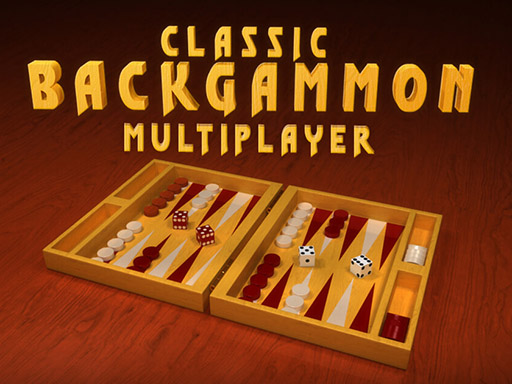
Backgammon Multiplayer has three modes: multiplayer, a game against the computer, or a friend on the same device; you tap the triangles to move. Backgammonia plays classic backgammon against the computer or a friend in two-player mode.
If you like the dice race but want something lighter, Ludo is a relative: you roll a die to move tokens from start to finish, and opponents can send your tokens back. Ludo Legend plays alone or with friends on one device, and Ludo Online adds a bot mode and private games with friends. How to play Ludo covers its rules.

More board games are in the strategy collection and the 2-player category. For another two-player classic, see how to play checkers.
Backgammon FAQ
Can you move one checker with both dice?
Yes. You may move one checker the total of both dice, as long as the point where it stops after the first number is open.
What happens if you cannot move in backgammon?
You play whatever part of the roll is legal and lose the rest. If no part is legal, your turn ends without a move.
Do you need an exact roll to bear off?
No. If the roll is higher than your highest occupied point, you bear off a checker from that highest point. If you have a checker on a higher point, you must move it instead.
Which way do the checkers move?
Each player moves toward their own home board, so the two sides travel in opposite directions around the board.
Learn the setup, the bar and the bear-off rule first; the strategy grows from there, one roll at a time.